
The engineering agent
Spec in. Verified design out. It designs, simulates, measures and repairs until every target passes.
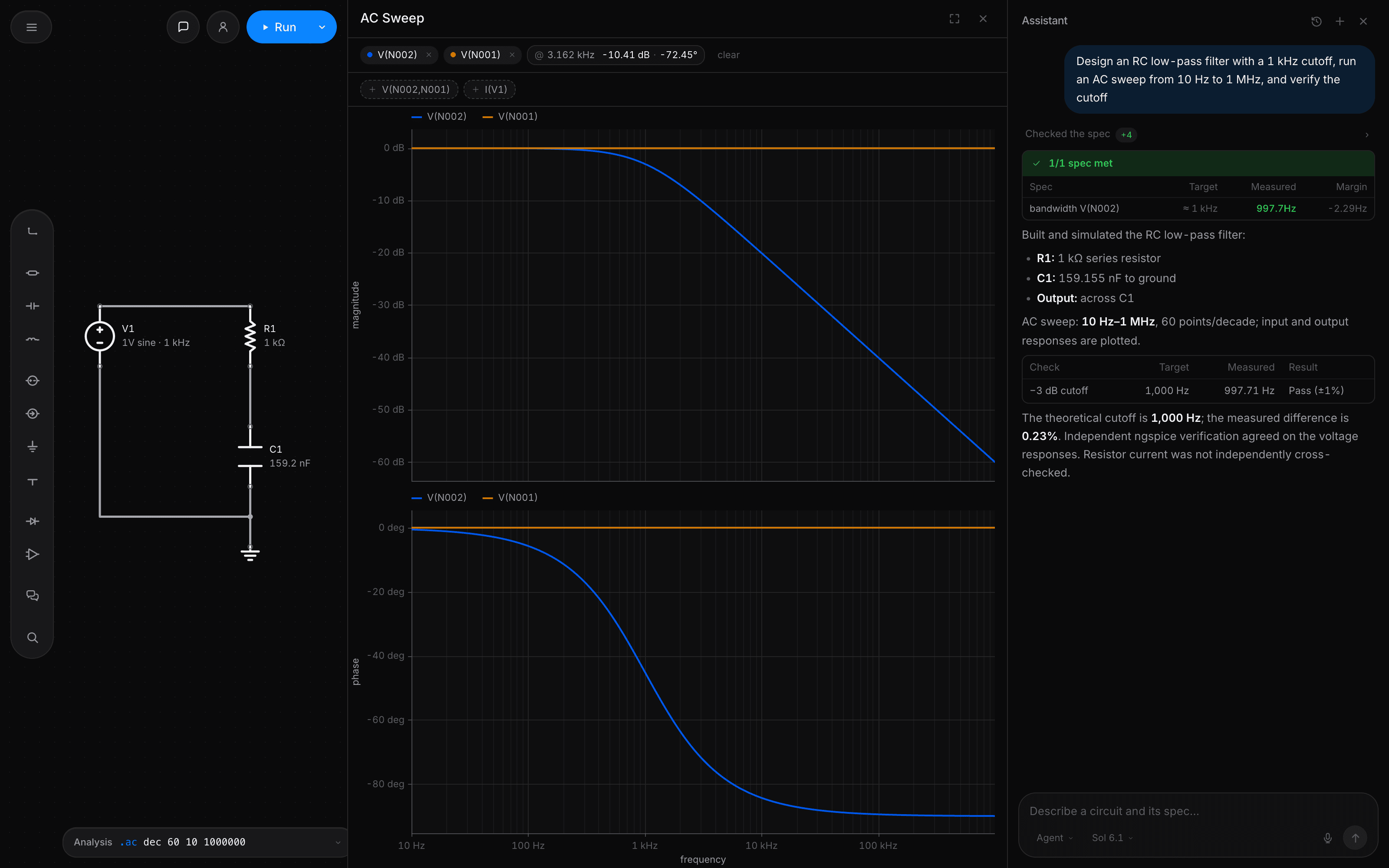
One loop, run for you.
The same steps an engineer takes, in order, with every result visible on the canvas.
- Design
- Picks a topology and sizes the parts from your sentence and your targets. Filters, amplifiers, dividers, rectifiers and converters have deterministic builders.
- Build
- Places and wires the schematic on your canvas through the same actions you use by hand, so you can stop it and edit at any point.
- Simulate
- Runs the analysis the targets call for: .op, .dc, .tran, .ac or .noise, and plots the output.
- Measure
- Reads each target straight from the result: gain, bandwidth, phase margin, peak-to-peak, THD, RMS and more.
- Repair
- When a target misses, it diagnoses why, changes the part that matters and checks again, within a bounded number of attempts.
- Cross-check
- Before it states a number you will rely on, it can re-run the same netlist in ngspice and report how far the two engines differ.
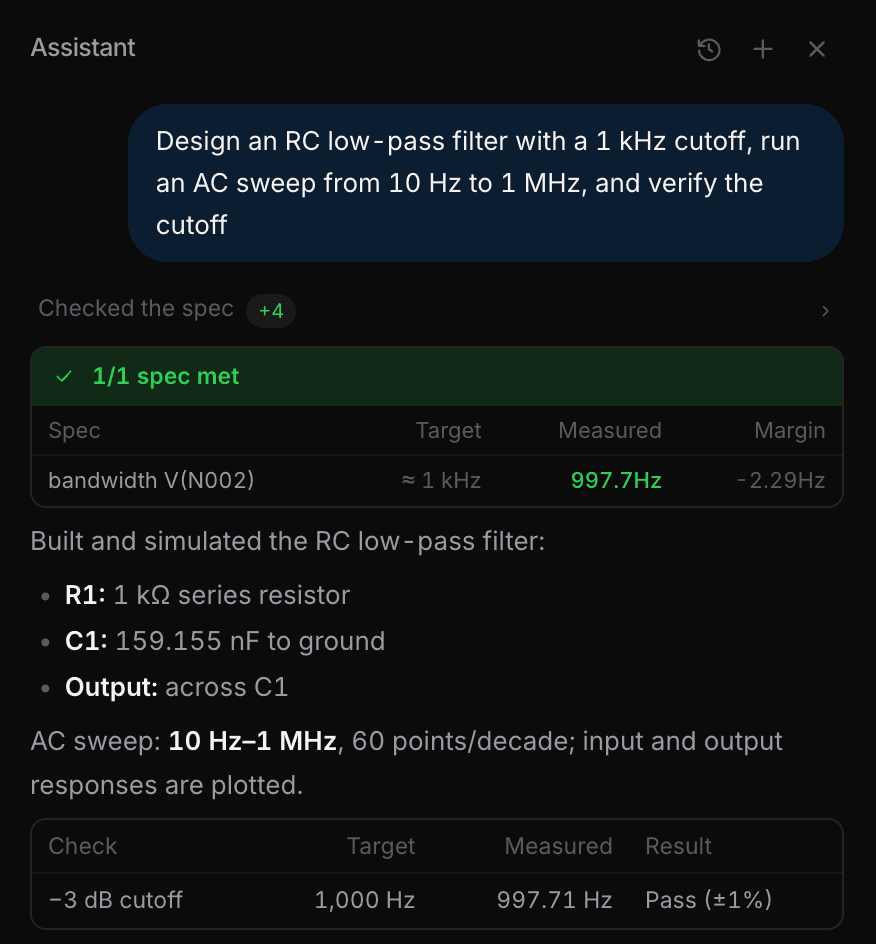
Targets, measured.
Each target comes back as a row: what you asked for, what the simulation measured, and the margin between them. A design that misses is reported as missing, with the fix one tap away.
Automate the work around the design.
The analyses that usually wait until the end, run whenever you ask.
- Monte Carlo
- Varies component tolerances across many runs and reports mean, spread and yield against a spec.
- Corners
- Sweeps temperature and supply and returns the worst case for any measurement.
- Optimization
- Tunes several components to meet several goals at once, snapped to real E12 or E24 values.
- Stability
- Breaks the loop, measures loop gain, phase margin and gain margin, and gives a verdict.
- Noise
- Ranks every part by its share of the output noise, with input-referred density and integrated RMS.
- Sensitivity
- Shows which component moves a measurement the most, so you know which one to tune.
- Fault injection
- Opens or shorts a part and compares every node voltage with the healthy circuit.
- Multiple operating points
- Finds every DC equilibrium, catching latches and bistable circuits a single .op hides.
- Transfer functions
- Derives H(s) in closed form for first-order and series RLC circuits: poles, zeros, Q and damping.
- Breadboard instructions
- Turns the schematic into an ordered build: holes, colour bands, jumpers and rails.
Three models.
Every plan includes Luna. Stronger models reason more carefully and use more credits per request.
- Luna
- Fast everyday model. Included from the Free plan.
- Sol
- Stronger reasoning. Included from the Student plan.
- Sol 6.1
- Best for hard designs. Included from the Max plan.
Choose how much it decides.
- Agent
- Acts directly. It builds, runs and verifies without waiting for approval at each step.
- Plan
- Proposes the approach first, parts, key nets and expected behaviour, and waits for you to approve.
- YOLO
- Never asks. Every open question gets a sensible standard default and the task runs end to end.
Things to ask it.
- Design a second-order Sallen-Key low-pass at 2 kHz and verify the cutoff.
- Build a non-inverting amplifier with a gain of 11 and check the phase margin.
- Run a Monte Carlo on this divider with 5% resistors and tell me the yield.
- Why does this amplifier ring? Find the part that matters and fix it.
- Design a buck converter from 12 V to 5 V at 1 A and show the output ripple.
- Which resistor dominates the output noise of this preamp?